
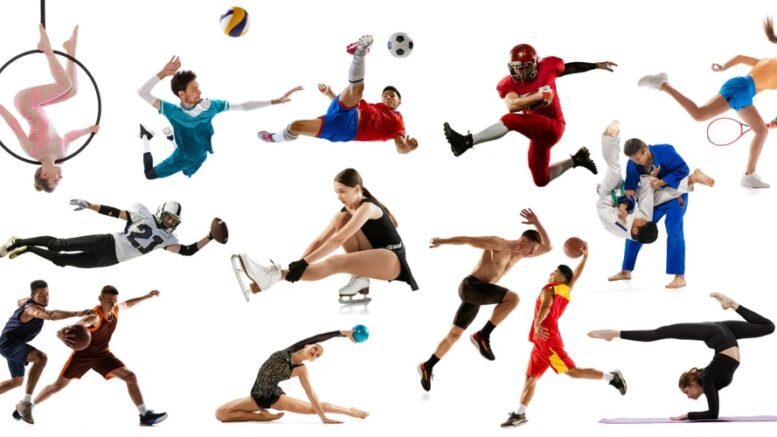
While many aspire to emulate the legendary feats of icons like Michael Jordan or Novak Djokovic, physiological factors—specifically stature—often play a significant role in determining an athlete’s ceiling of success. New data suggests that professional achievement is frequently linked to how well an individual’s height aligns with the specific mechanical demands of their chosen discipline. According to a recent analysis by Casino Kings, elite sports often favor specific height ranges, suggesting that natural excellence may depend on how closely an athlete matches the dominant physical patterns of their field.
Comparative Height Benchmarks Across Global Professional Sports
- Basketball: 6’7” (2.01m)
- American Football & Rugby: 6’2” (1.88m)
- Tennis: 6’1” (1.85m)
- Soccer: 5’11.5” (1.82m)
- Golf: 5’11.5” (1.82m)
- Cricket: 5’11” (1.81m)
- Mixed Martial Arts (MMA): 5’10.5” (1.79m)
- Formula 1 Racing: 5’10” (1.78m)
- Gymnastics: 5’3” (1.60m)
- Horse Racing: 5’2” (1.57m)
Analyzing the Biomechanical Impact of Stature on Athletic Achievement
Basketball: It is no surprise that basketball players represent the tallest demographic in professional sports, with an average height of 6’7” (2.01m). In this arena, height is a fundamental asset for both offensive scoring and defensive maneuvers. A taller frame provides superior reach for blocking shots and the ability to shoot over defenders. While many fans look to Michael Jordan as the ultimate benchmark, even he stood at a towering 6’6” (1.98m), illustrating the importance of a significant vertical presence in the elite leagues.
American Football & Rugby: Ranking second for average height, these athletes typically stand around 6’2” (1.88m). In these contact-heavy sports, height provides a distinct advantage in field vision and physical positioning. However, size must be carefully balanced with raw power and cardiovascular endurance to sustain performance throughout a match.
Tennis: Professional tennis players are generally taller than the average person, with a standard height of approximately 6’1” (1.85m). From a tactical perspective, a taller stature is highly beneficial as it allows for greater leverage during serves, increasing ball velocity. Furthermore, longer limbs provide an extended reach, allowing players to cover more of the court with fewer steps. Novak Djokovic, widely considered one of the greatest to play the game, stands at 6’2” (1.88m).
Soccer: The average height for professional soccer players is 5’11.5” (1.82m), which aligns closely with global averages. However, body types in soccer are highly specialized by position. While goalkeepers and central defenders often require more height to dominate the air, midfielders and forwards may have more varied statures depending on whether their role prioritizes explosive speed, agility, or playmaking.
Golf: With an average height of 5’11.5” (1.82m), golf is a sport where stature has a more subtle impact. While height can improve swing mechanics and provide better leverage for power hitting, it is not a prerequisite for success in the same way it is for contact sports. Precision and technique remain the primary drivers of elite performance.
Cricket: At an average of 5’11” (1.81m), cricket showcases a clear divide based on player roles. Fast bowlers frequently use their height to generate steeper bounce and more difficult angles for the batsman. In contrast, spin bowlers and batsmen often have more compact builds, which can aid in quick footwork, timing, and refined motor control.
Mixed Martial Arts (MMA): Elite martial artists average around 5’10.5” (1.79m). In combat sports, height is often secondary to weight classes, which act as the primary equalizer. While a longer reach can be an advantage in striking, compact athletes often find success through lower centers of gravity and different wrestling or grappling advantages.
Auto Racing: Formula 1 drivers are slightly shorter than the multi-sport average, typically standing at 5’10” (1.78m). Legend Lewis Hamilton is even more compact at 5’7” (1.74m). In racing, being shorter is often a logistical advantage, as car cockpits are extremely confined and lower body weight can improve the car’s overall power-to-weight ratio and aerodynamics.
Gymnastics: Athletes in this discipline are among the shortest in the world of professional sports, averaging 5’3” (1.60m). A smaller, more compact frame is a significant mechanical advantage here, as it allows for faster rotational speeds, better air awareness, and greater stability when performing complex maneuvers on the bars, beam, or floor.
Horse Racing: Jockeys are the most compact professional athletes, with an average height of 5’2” (1.57m). This is primarily due to the stringent weight requirements of the sport. Because jockeys must remain light to allow the horse to reach maximum speed, a shorter stature is almost a requirement for eligibility at the professional level.
Ultimately, while sports like basketball and rugby may favor those with significant height, the diversity of professional athletics ensures that there is a competitive niche for every body type. Whether height provides leverage and reach or a compact frame offers agility and speed, physical traits are just one part of the complex equation of sporting success.
Be the first to comment on "The Height Factor: Which Sport Were You Actually Built For?"