
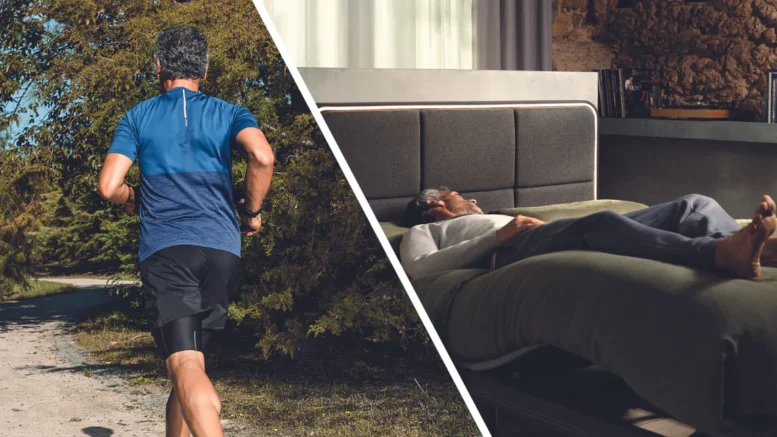
Ask any serious athlete what separates a good training block from a great one, and you will hear the usual suspects. Programming. Nutrition. Mobility work. Mindset. Recovery modalities like ice baths, compression boots and infrared saunas. What you rarely hear, at least not first, is the one variable that quietly governs every other input: sleep.
This is a strange oversight, because the evidence is no longer subtle. Sleep is not a passive recovery activity that happens between sessions. It is the period in which the body actually does the work of adapting, repairing and consolidating everything you trained for during the day. Skip it, shorten it or fragment it, and the rest of the plan begins to crack.
For anyone training four or five times a week, balancing work, family and ambition, the relationship between sleep and sports recovery is not a wellness talking point. It is the difference between progressing and plateauing, between feeling resilient and feeling brittle, between hitting the next gear and grinding on fumes. This piece looks at why sleep deserves to be treated as a first-tier training variable, what the research actually says, and how athletes at the highest level are now building their schedules around it.
Why Sleep Has Become the Quiet Revolution in Performance
For most of modern sports science history, sleep was treated as a background process. Coaches obsessed over load management, S&C protocols and macros. Sleep, if it came up at all, was lumped under “lifestyle factors”, somewhere between hydration reminders and a vague nod to stress management.
That has shifted decisively over the past fifteen years. Research from sleep scientists, sports physiologists and elite team performance staff has converged on a clear point. The athletes who sleep well consistently outperform, outlast and out-recover those who do not, even when training, diet and genetics are broadly matched.
Dr Matthew Walker, professor of neuroscience and psychology at UC Berkeley and author of Why We Sleep, has been one of the most vocal scientific voices on this. His work, alongside research published in journals like Sleep, Journal of Sports Sciences and the British Journal of Sports Medicine, has reframed sleep from a soft recovery tool into a measurable performance lever. Reaction time, accuracy, sprint speed, injury risk, hormone profile, glucose handling and cognitive decision making all track closely with sleep quantity and quality.
The primary keyword here matters. Sleep and sports recovery are no longer separate conversations. They are the same conversation. Recovery, in the truest physiological sense, mostly happens while you are unconscious.
The Science of Sleep and Recovery
To appreciate why sleep is so non-negotiable for athletes, it helps to understand what the body is actually doing during those seven to nine hours.
Sleep is not a uniform state. It cycles through distinct stages roughly every 90 minutes, each with its own physiological signature. Across a full night, you typically move through four to six of these cycles, with the balance of stages shifting as the night progresses. The early part of the night is heavier in deep sleep. The latter part is richer in REM. Cutting sleep short does not just shave time off the end. It disproportionately strips out the stages most relevant to athletic performance and sleep.
A meta-analysis published in Sports Medicine found that sleep extension and sleep optimisation interventions in athletes produced measurable improvements in sprint times, shooting accuracy, serve precision and perceived fatigue. The effect sizes were not trivial. In some studies, the gains rivalled what athletes typically chase through additional training or supplementation.
The body uses sleep to do four things that no other recovery method can replicate:
- Release pulses of growth hormone tied to muscle repair and tissue remodelling
- Restore central nervous system function, which governs power output and coordination
- Clear metabolic waste products from the brain via the glymphatic system
- Consolidate motor learning and tactical patterns from training into long-term memory
You cannot ice bath your way to these adaptations. You cannot supplement them. You can only sleep them.
Sleep Stages and Why Each One Matters
Most people have heard of REM and deep sleep, but few athletes train with a working understanding of what each stage does. That gap is worth closing, because it changes how you think about bedtime, wake time and the architecture of your night.
Stage 1 and Stage 2: The Bridge
The first two stages of non-REM sleep are transitional. Heart rate slows. Body temperature drops. Brainwaves begin to lengthen. Stage 2 makes up roughly half of total sleep time across the night and plays a role in motor skill consolidation, particularly for technical sports. Tennis players, golfers, combat athletes and anyone refining a complex movement pattern benefit from this stage more than they realise.
Deep Sleep: The Repair Phase
Slow-wave sleep, commonly called deep sleep, is where the heavy physical recovery happens. This is when the pituitary gland releases the largest pulses of growth hormone, when muscle protein synthesis is most active, and when the body carries out the bulk of its muscle and recovery repair work.
Deep sleep and muscle repair are tightly linked. Studies have shown that suppressing slow-wave sleep, even while keeping total sleep duration constant, impairs glucose metabolism, blunts growth hormone release and degrades next-day physical output. For athletes carrying heavy training loads, deep sleep is not optional. It is the engine room of recovery.
Deep sleep is also concentrated in the first third to half of the night, which is why “going to bed late but sleeping in” is not a fair trade. You lose the highest-yield part of the night and try to compensate with the lowest.
REM Sleep: The Cognitive Layer
REM sleep, characterised by rapid eye movements and dream activity, is where the brain does much of its consolidation work. Motor patterns, decision-making heuristics, emotional regulation and memory all benefit. For team sport athletes, racket sport players, combat athletes and anyone whose performance depends on split-second reads, REM sleep recovery is arguably as important as the physical repair happening earlier in the night.
REM is concentrated in the second half of the night. Athletes who routinely wake early without adjusting their bedtime quietly amputate their REM cycles. The deep sleep got banked. The cognitive sharpness did not.
This is why total sleep duration matters, but so does the timing and completeness of each cycle. An athlete getting six hours is not just twenty-five per cent short of an eight-hour night. They are losing a disproportionate slice of REM and the deeper restorative cycles that build on it.
What Actually Happens When Athletes Are Sleep-Deprived
Sleep deprivation in athletes does not look like exhaustion. It looks like underperformance the athlete cannot quite explain. Slightly slower. Slightly heavier. Slightly off. The mirror still shows a trained body. The numbers on the bar or the watch tell a different story.
The physiological cost is well documented. A landmark study from Stanford University, led by Cheri Mah, tracked the men’s basketball team across a season as they extended their sleep to around ten hours per night. Sprint times improved. Free throw accuracy increased by roughly nine per cent. Three-point shooting improved by a similar margin. Reaction times sharpened. Mood scores climbed. None of the players changed their training. They just slept more.
Research published in the Journal of Sports Sciences and elsewhere has shown that restricting sleep to five or six hours per night for as little as a week produces a cluster of measurable effects:
- Reduced time to exhaustion in endurance protocols
- Lower peak power output in sprint and jump tests
- Impaired glucose tolerance, similar in some studies to a pre-diabetic state
- Elevated cortisol and suppressed testosterone
- Increased perception of effort at the same workload
- Slower reaction times comparable to mild alcohol intoxication
- Significantly higher injury risk in young athletes
That last point is worth dwelling on. A study published in the Journal of Pediatric Orthopaedics found that adolescent athletes who slept less than eight hours per night were roughly 1.7 times more likely to sustain an injury than those who slept more. Other research in adult populations has shown similar patterns. Fatigue erodes the small stabilising contractions, the proprioceptive precision and the decision making that keep an athlete out of bad positions. When sleep deprivation in athletes is sustained, injury rates climb.
There is also the hormonal picture. Testosterone is largely produced during sleep, with peaks in the early morning hours that depend on a complete night. One week of restricted sleep can reduce daytime testosterone levels in healthy young men by ten to fifteen per cent, a drop equivalent to ageing by ten to fifteen years. For athletes chasing strength, recovery, body composition and libido, that is not a marginal cost.
Cognitive effects compound the physical ones. Sleep-deprived athletes make worse tactical decisions, misread defensive shapes, mistime passes and lose the fine motor accuracy that distinguishes elite from very good. The body might still be capable. The nervous system running it is not.
How Elite Athletes and Organisations Are Now Treating Sleep
The professional sport world has moved faster on this than most amateur athletes realise. Sleep is now an explicit performance pillar at the highest levels, with dedicated staff, technology and protocols built around it.
Roger Federer reportedly aimed for around twelve hours of sleep per day across the night and naps during his peak years. LeBron James has spoken publicly about targeting nine to ten hours, with naps layered in. Cristiano Ronaldo is known for sleeping in multiple short blocks rather than a single long one, working with a sleep coach to optimise his architecture. Usain Bolt repeatedly described sleep as the most important part of his training.
These are not eccentricities. They reflect an understanding that the body cannot bank repeated high-intensity output without restoring the system that produces it.
At organisational level, the shift is even clearer. Premier League clubs, NBA franchises, NFL teams, Formula 1 outfits and Olympic federations now employ sleep specialists. Many travel with bespoke mattresses, blackout kits and bedding for their players. Tom Brady’s well-publicised TB12 protocols included sleepwear designed around recovery, regardless of what one thinks of the marketing.
Team GB worked extensively with sleep researchers in the build up to recent Olympic Games, with athletes given individualised sleep profiles and protocols for managing time zones, competition nerves and irregular schedules. England Rugby, the All Blacks and elite cycling teams like Ineos Grenadiers have invested in similar work. Manchester City and Liverpool have both publicly discussed how sleep monitoring informs training load decisions.
The point is not that elite athletes do exotic things ordinary athletes cannot. The point is the opposite. The intervention that consistently rises to the top of professional performance programmes is the one most accessible to everyone. Sleep more. Sleep better. Sleep on a schedule.
Practical, Evidence-Based Sleep Optimisation for Athletes
If you train four or five times a week, the gap between your current sleep and your potential sleep is almost certainly the highest-yield intervention available to you. The good news is that sleep optimisation for athletes is not complicated. It is just unglamorous and requires consistency.
Anchor your wake time
The single most underrated lever in sleep quality is a consistent wake time, including weekends. Your circadian rhythm is governed by the timing of light exposure and wakefulness, not by when you fall asleep. A fixed wake time pulls everything else into alignment, including the time you naturally feel sleepy in the evening. Drift the wake time and the whole system loses its rhythm.
Aim for seven and a half to nine hours in bed
Most adults need around seven and a half to nine hours of actual sleep, which usually means eight to nine and a half hours in bed once you account for falling asleep and brief night wakings. Recreational and competitive athletes often need the upper end of that range. If you are training hard on six and a half hours, you are not tougher than the people sleeping eight. You are just paying a hidden tax.
Treat the last ninety minutes as part of training
The transition into sleep is where most people sabotage themselves. Bright overhead lighting, late screens, late meals, late training, alcohol and unresolved work all delay sleep onset and degrade the early-night deep sleep that matters most. A simple wind-down protocol works: dim lights ninety minutes before bed, no overhead lighting, no work, no scrolling within the last thirty to forty-five minutes. The aim is not perfection. It is consistency. Mobility work that supports better sleep.
Manage light intentionally
Morning light exposure within thirty to sixty minutes of waking is one of the most powerful circadian signals available. Ten to fifteen minutes outside, ideally without sunglasses for at least part of it, sets the master clock for the day and improves sleep quality that night. In the evening, the opposite applies. Reduce overhead light, use warm low-level lighting, and consider blue-light filters on devices if you must use them late.
Keep the room cool and dark
Core body temperature needs to drop by around one degree Celsius to initiate sleep. A bedroom around 17 to 19 degrees Celsius supports this. Blackout curtains or a quality sleep mask remove ambient light that suppresses melatonin. Athletes living in cities or hotels should treat this as basic kit, not a luxury.
Use caffeine intelligently
Caffeine has a half-life of around five to six hours in most adults, and longer in slower metabolisers. An afternoon coffee at 3pm leaves a meaningful dose of caffeine in your system at 11pm, fragmenting sleep architecture even if you fall asleep without issue. A simple cut-off of around eight to ten hours before bed is sensible. Many elite athletes stop earlier.
Be honest about alcohol
Alcohol is one of the most disruptive substances for athletic sleep. It sedates you, which feels like sleep but is not. It suppresses REM, fragments deep sleep and increases night-time wakings, even at modest doses. There is no version of regular evening drinking that is compatible with optimal recovery. The occasional social drink is not a problem. Habitual evening alcohol is.
Use naps strategically
A twenty to thirty minute nap in the early afternoon can meaningfully restore alertness, reaction time and mood without interfering with night sleep. Longer naps risk pulling you into deep sleep and waking groggy, and can delay night-time sleep onset. Many elite athletes nap regularly on heavy training days. Recreational athletes can do the same.
Time your training where possible
Hard training in the late evening raises core temperature, cortisol and adrenaline, all of which can delay sleep onset. If your schedule forces late sessions, build in a longer cool-down, a warm shower (which paradoxically helps the body shed heat afterwards), and a deliberate wind-down. Where you have a choice, morning or early evening training is friendlier to sleep.
Track, but do not obsess
Wearables like Whoop, Oura and Garmin have made sleep architecture visible to anyone who wants it. Used well, they help you spot patterns, link behaviours to outcomes and make better decisions. Used badly, they create orthosomnia, the anxiety of trying to sleep perfectly because the score is watching. The score is a signal, not a verdict. Look at trends over weeks, not the readout of a single bad night.
Sleep as a Non-Negotiable, Not a Nice-to-Have
The shift the best athletes have made is not just behavioural. It is conceptual. Sleep stopped being something they fit around their training and became something their training fits around. It is the foundation, not the topping.
For anyone serious about performance, that reframe is worth making. The next personal best, the next injury-free season, the next stretch of feeling genuinely sharp rather than stale, almost certainly sits on the other side of an extra ninety minutes in bed and a more disciplined wind-down. Not a new programme. Not a new supplement stack. Not a fourth recovery gadget on the shelf.
Athletic performance and sleep are bound together in ways the body does not negotiate. You can ignore the relationship for a while. The training will hold up. The numbers will look acceptable. Then the small things start to slip. The sessions that should feel easy feel heavy. The niggles linger. The motivation thins. The reaction is half a beat off.
Treat sleep like a competitor treats a key training session. Schedule it. Protect it. Build the environment around it. Measure it without obsessing. Make it the first thing that gets defended in a busy week, not the first thing that gets sacrificed.
The athletes who do this consistently are not the ones with the most willpower or the most expensive recovery setup. They are the ones who understood, earlier than most, that the body adapts in the dark.
Be the first to comment on "Sleep and Sports Recovery: The Most Underrated Performance Tool in Modern Athletics"